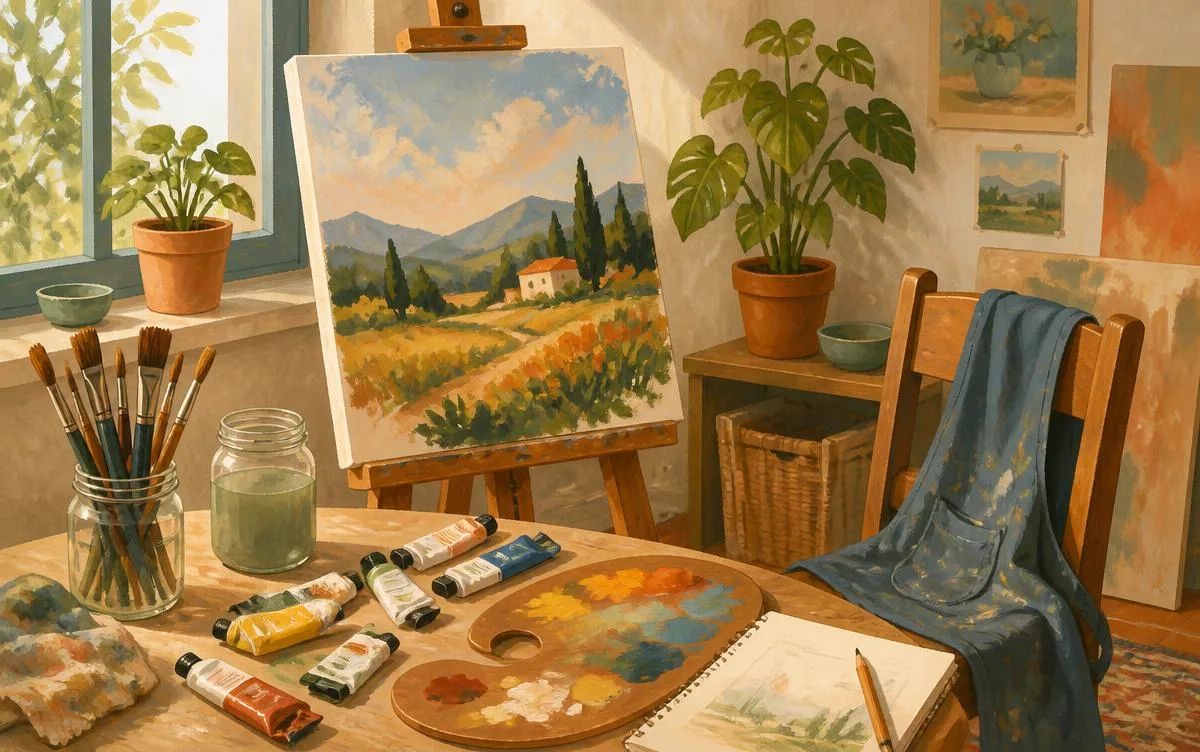
A short list of decent materials, and somewhere you can leave a mess for an hour.
Painting is unusually forgiving to start: a limited palette, three brushes and a stack of primed paper will carry you through months of learning.
Better materials do help, but only in a few specific places. This list says where it is worth spending and where it genuinely is not. Mark what you already have.
Paint and surfaces
0 of 4
A small amount of good paint on a decent surface beats the opposite every time.
Acrylic or oil paints
A small set of good paint mixes far more colours than a big set of weak paint, and the difference is visible immediately.
Why you need it. A small set of good paint mixes far more colours than a big set of weak paint, and the difference is visible immediately.
What to look for. Student-grade or better in a limited palette: two blues, two reds, two yellows, plus white. Buy a large white tube, you will use it fastest.
Canvases or painting paper
Working on cheap surfaces makes decent paint behave badly. Surfaces are also where beginners most often overspend.
Why you need it. Working on cheap surfaces makes decent paint behave badly. Surfaces are also where beginners most often overspend.
What to look for. A pad of primed painting paper or canvas board for practice, in a size you can finish in one sitting. Save stretched canvas for pieces you like.
Gesso primer
Primer stops the surface drinking your paint and gives brushes something to move across.
Why you need it. Primer stops the surface drinking your paint and gives brushes something to move across.
What to look for. A tub of white acrylic gesso and a cheap wide brush to apply it. Two thin coats beat one thick one.
Varnish
Varnish protects a finished painting from dust and evens out patchy shine so the colours look as intended.
Why you need it. Varnish protects a finished painting from dust and evens out patchy shine so the colours look as intended.
What to look for. A removable acrylic or oil varnish in satin or matte, applied only once the paint is fully cured.
Brushes and mixing
0 of 4
Three good brushes and a proper palette teach you colour quickly.
Brush set
Different shapes do different jobs. Three good brushes in the right shapes will outperform a bargain pack of twelve.
Why you need it. Different shapes do different jobs. Three good brushes in the right shapes will outperform a bargain pack of twelve.
What to look for. A flat, a round and a small detail brush, in synthetic for acrylics or hog bristle for oils. Wash them properly and they last years.
Palette
Mixing on a proper palette is how you learn colour. Mixing on a plate teaches you very little.
Why you need it. Mixing on a proper palette is how you learn colour. Mixing on a plate teaches you very little.
What to look for. A tear-off paper palette for easy cleanup, or a sealed stay-wet palette if you paint in acrylics over several sessions.
Palette knife
A knife mixes paint without wearing out brushes, and doubles as a tool for texture.
Why you need it. A knife mixes paint without wearing out brushes, and doubles as a tool for texture.
What to look for. A flexible steel knife with an offset handle, medium sized. One is genuinely enough to start.
Water jars and rags
Two jars keep your colours clean, one for washing and one for mixing. Rags do the rest of the work.
Why you need it. Two jars keep your colours clean, one for washing and one for mixing. Rags do the rest of the work.
What to look for. Two sturdy jars, a roll of paper towel and a couple of cotton rags. For oils, use solvent-safe jars with lids.
A space to work
0 of 5
Ten minutes of setting up buys hours of relaxed painting.
Easel
Painting flat distorts what you see. An easel gets the work upright and your shoulder moving freely.
Why you need it. Painting flat distorts what you see. An easel gets the work upright and your shoulder moving freely.
What to look for. A tabletop easel for small work or a light sketching easel for larger pieces. Check it holds your largest planned canvas steady.
Apron or old clothes
Acrylic paint is permanent on fabric, and worrying about your clothes makes for cautious painting.
Why you need it. Acrylic paint is permanent on fabric, and worrying about your clothes makes for cautious painting.
What to look for. A cotton apron with pockets, or clothes you have already given up on. Both work equally well.
Dust sheet
Ten minutes of covering the floor buys hours of relaxed, messy work.
Why you need it. Ten minutes of covering the floor buys hours of relaxed, messy work.
What to look for. A cheap plastic or canvas dust sheet, plus masking tape to hold it down. Canvas is less slippery underfoot.
Sketchbook and pencils
Most bad paintings are composition problems. Five minutes of thumbnail sketches solves them before you open the paint.
Why you need it. Most bad paintings are composition problems. Five minutes of thumbnail sketches solves them before you open the paint.
What to look for. A hardback sketchbook you are not precious about, a couple of graphite pencils and a soft eraser.
Masking tape
Clean edges, taped-down paper and neat borders. It is also how you keep watercolour paper flat.
Why you need it. Clean edges, taped-down paper and neat borders. It is also how you keep watercolour paper flat.
What to look for. Low-tack artist or masking tape in a narrow width, which lifts off without tearing the surface.